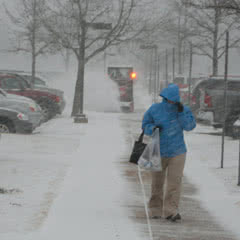
Winters in Missouri bring the potential for dangerous snow and ice storms, which can lead to hazardous driving conditions, the loss of heat and electricity and other risks to life and safety. Extended periods of sub- freezing temperatures can also pose hazards. The best way to prepare is to plan ahead and follow local weather forecasts and news reports. Also, think about the winter hazards discussed here and select an icon to learn more.
Winter Driving Safety
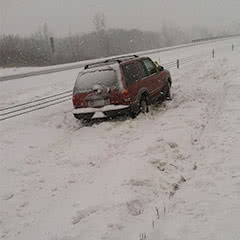
When it’s snowing or a major snowstorm is in the forecast, there’s nothing more important for your safety and the safety or others than the decisions you make about driving. Avoiding a non-essential trip during a snowstorm might not only prevent a traffic crash, it can allow road crews to clear roads more quickly and keep you from becoming stranded. Before hitting the road, decide whether the trip is necessary. If you must drive when it’s snowing, here are some safety tips from the Missouri State Highway Patrol.
Follow the local weather forecast and traffic reports. Plan travel during times when snow or icing are not in the forecast. Avoid unnecessary travel.
Reduce speed and increase following distance. Drive based on conditions, NOT the posted speed limit.
Focus 100 percent on driving because you have less control of your vehicle and less visibility. Use your headlights to increase your visibility to other drivers.
Understand that bridges and overpasses often ice over sooner than other parts of the road.
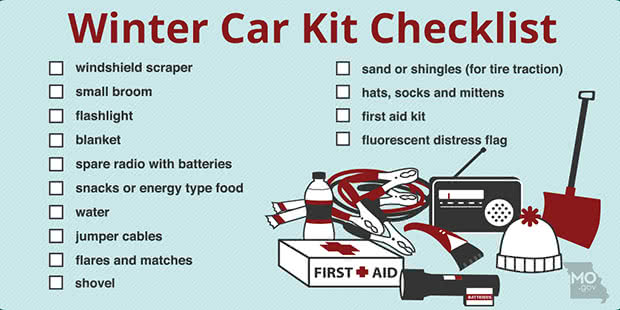
Place an ice scraper, battery booster cables, blankets, extra coats, gloves, water, non-perishable food, flashlight, and a bag of sand or cat litter in your trunk.
Keep you gas tank at least half full.
Travel with a fully charged cell phone. Park your vehicle before calling if you need help. *55 on a cellular phone connects you to the closest Missouri State Highway Patrol headquarters.
Clear your vehicle’s windows completely before driving to ensure visibility.
Never overreact or slam on the brakes. If you begin to slide, steer in the direction of the slide to regain control of the vehicle.
Understand 4-wheel-drive vehicles may provide extra traction to get a vehicle moving in snow, but they are not better at braking or handling turns.
If you must travel in a snow storm, let others know about your route, destination and estimated time of arrival.
If you become stranded in deep snow and are idling the engine to keep warm, be sure to keep the area around the tailpipe clear to avoid carbon monoxide poisoning inside the vehicle. Also, open a window slightly to let in fresh air.
What to Do if you Get Stranded
Staying in your vehicle when stranded is often the safest choice if winter storms create visibility so poor that you can’t see or if roadways are ice covered. These steps will increase your safety when stranded:
Tie a brightly colored cloth to the antenna as a signal to rescuers.
Move anything you need from the trunk into the passenger area.
Wrap your entire body, including your head, in extra clothing or blankets.
Stay awake. You will be less vulnerable to cold-related health problems.
Run the motor (and heater) for about 10 minutes per hour, opening one window slightly to let in air. Make sure that snow is not blocking the exhaust pipe—this will reduce the risk of carbon monoxide poisoning.
As you sit, keep moving your arms and legs to improve your circulation and stay warmer.
Do not eat unmelted snow because it will lower your body temperature.
Huddle with other people for warmth.
Staying Safe in Your Home during a Winter Power Outage
The loss of power and heat for extended periods during a winter storm can create potential safety risks in your home. As families prepare to use generators and alternate heat sources to keep warm, it is essential that they are aware of the risks and hazards to ensure personal safety.
If you lose heat to your home, temporarily close off less essential rooms and remain in one area of the residence. Keep warm by wearing several layers of clothing, gloves and a wool hat. Eat regularly and drink ample fluids, but avoid caffeine and alcohol.
Flashlights and battery-powered lighting should be kept in the home and ready to use during a power outage. NEVER use candles as a light source. Generators should never be operated indoors and must be well vented to prevent fumes from entering a home.
When using kerosene heaters maintain ventilation to avoid a build-up of toxic fumes. Refuel kerosene heaters outside and keep them at least three feet from flammable objects. If the pipes freeze, remove any insulation or layers of newspapers and wrap pipes in rags. Completely open all faucets and pour hot water over the pipes, starting where they were most exposed to the cold (or where the cold was most likely to penetrate).
Whenever an ice storm or some other weather event has the potential to knock out power, charge your family’s cell phones to make sure you’ll have a way to communicate and get information if power is lost.
Extended exposure to extremely cold temperatures, particularly if there are high winds, can present serious health hazards. During bitter cold temperatures it’s important to make trips outdoors as brief as possible and to remember these safety tips.
Dress Warmly and Stay Dry
Begin by dressing correctly for the cold. Several layers of loose-fitting clothing is a good way to start. Then remember the following: a hat; a scarf or knit mask to cover your face and mouth; sleeves that are snug at the wrist; mittens, which are warmer than gloves; and a water-resistant coat and boots.
An outer layer that is tightly woven, preferably wind resistant, will reduce body-heat loss caused by wind. Wool, silk, or polypropylene inner layers of clothing hold more body heat than cotton. Stay dry—wet clothing chills the body rapidly. Excess perspiration will increase heat loss, so remove extra layers of clothing whenever you feel too warm. Do not ignore shivering. It’s an important first sign that the body is losing heat. Persistent shivering is a signal to return indoors.
Understanding Frostbite and Hypothermia
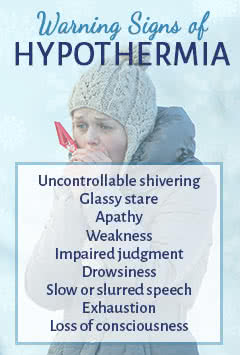
Frostbite is an injury to the body that is caused by freezing. Frostbite causes a loss of feeling and color in affected areas. It most often affects the nose, ears, cheeks, chin, fingers, or toes. Frostbite can permanently damage the body. The risk of frostbite is increased in people with reduced blood circulation and among people who are not dressed properly for extremely cold temperatures.
When exposed to cold temperatures, your body begins to lose heat faster than it can be produced. Prolonged exposure to cold will eventually use up your body’s stored energy. The result is hypothermia, or abnormally low body temperature. Body temperature that is too low affects the brain, making the victim unable to think clearly or move well. This makes hypothermia particularly dangerous because a person may not know it is happening and won’t be able to do anything about it.
Hypothermia is most likely at very cold temperatures, but it can occur even at cool temperatures (above 40°F) if a person becomes chilled from rain, sweat, or submersion in cold water.
Staying Safe When Shoveling Snow
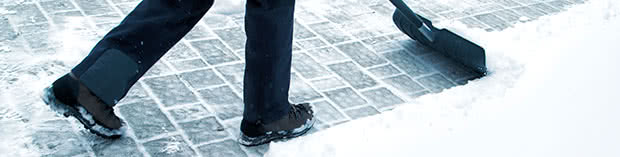
Check with your doctor. Because shoveling can place high stress on the heart, speak with your physician first. If you have a medical condition or do not exercise regularly, consider hiring someone to remove the snow.
Dress appropriately. Light, layered, water-repellent clothing provides both ventilation and insulation. It is also important to wear the appropriate head coverings, as well as mittens or gloves and thick, warm socks. Avoid falls by wearing shoes or boots that have slip-resistant soles. Take a break if you feel yourself getting too hot or too cold.
Watch for ice patches and uneven surfaces. Make sure that your hat or scarf does not block your vision. Be aware of your surroundings and alert for snow plows if you go into the street to dig out a vehicle.
Clear snow early and often. Begin when a light covering of snow is on the ground to avoid trying to clear packed, heavy snow. Take frequent breaks and replenish fluids to prevent dehydration. If you experience chest pain, shortness of breath or other signs of a heart attack, seek emergency care
When possible, push the snow instead of lifting it. If you must lift, take small amounts of snow, and lift it with your legs: Squat with your legs apart, knees bent and back straight. Lift by straightening your legs, without bending at the waist. Then walk to where you want to dump the snow; holding a shovelful of snow with your arms outstretched puts too much weight on your spine.
Do not throw the snow over your shoulder or to the side. This requires a twisting motion that stresses your back.
Use a shovel that is comfortable for your height and strength. Do not use a shovel that is too heavy or too long for you. Consider buying a shovel that is specially designed to prevent too much stooping. Space your hands on the tool grip to increase your leverage.
Winter Ice and Water Safety
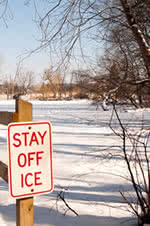
What may appear to be frozen over lakes or ponds can be inviting spots for ice skaters and children who would like to explore during Missouri’s winter months. Even in bitter cold temperatures, ice conditions on bodies of water can be extremely uncertain. The only guaranteed safe skating ice is at a skating rink.
Ice found on natural bodies of water raises the risk of danger due to natural variables. There is no way to judge the strength and safety of ice by looking at it or by the temperature of the day. Fluctuating temperatures, exposure to sunlight and other factors affect the consistency of the ice. It can be a several inches thick in one spot and only an inch thick 10 feet away.
Be especially wary of ice covered with snow. Snow can hide cracks and weaknesses in open ice. Parents should educate their children about the danger of going out onto a frozen body of water, including never following a friend or a pet into these potential danger zones.
From 2015 through 2018, 34 of Missouri’s 39 flooding deaths – 87 percent – were people who had been in vehicles. In 2015, alone, flooding killed 27 people in Missouri, more than the previous seven years combined and the highest total since 1993. Twenty-three of the 27 people who died had been in motor vehicles. Flash flooding is the leading cause of flooding deaths and historically more than half of the people killed by flooding were in motor vehicles.
Facts to Help Stop Flooding Deaths in Missouri
Never expect barriers to block off flooded low-water crossings or bridges because floodwaters often rise so quickly authorities cannot close a road in time.
Some motorists never see the high water until it’s too late because of poor visibility due to darkness or heavy rain.
Be alert for high water whenever flash flooding is forecast. Slow down when visibility is limited.
Don’t drive if you don’t have to when flash flooding is occurring in your area.
Turn around. Don’t drown.
Never think that because you made it across a flooded low water crossing in the past that you’ll make it the next time. Many areas saw record flooding in 2015 and others will in the future.
Never be tempted to drive into floodwater because it appears shallow. Looks are deceiving and the roadway may not be intact. Floodwater often washes out roads or compromises their structural integrity.
Less than a foot of moving water is enough to push a vehicle.
Cars will float when the force of the water is greater than the force of friction. Sand and mud that come with flash flooding reduce the friction force of gravity holding the car in place
Think about everything you could lose before trying to save a few minutes by not turning around.
If you wind up in flood water and your vehicle stalls, leave it immediately and seek higher ground. Rapidly rising water may engulf the vehicle and sweep it away.
On average, flash flooding kills 140 people each year in the U.S.
Flash Flood Safety Rules at Home or Work
When a flash flood watch is issued…be alert to signs of flash flooding and be prepared to evacuate on a moment’s notice
When a flash flood warning is issued for your area, or the moment you realize that a flash flood is imminent, act quickly to save yourself. You may only have seconds!
Go to higher ground – climb to safety.
Get out of areas subject to flooding. This includes dips, low spots, canyons, washes, etc.
Avoid already flooded and high velocity flow areas. Do not attempt to cross flowing streams.
Do not camp or park your vehicle along streams and washes, particularly during threatening weather conditions.
Children should never play around high water, storm drains, viaducts or arroyos.
If you come upon a flowing stream where the water is above your ankles, stop! Turn around and go another way. If water is moving swiftly, even water six inches deep can knock you off your feet.
Flash flooding fatalities statistics provided by the National Weather Service.
Honoring Missourians in the Korean War
Jul 25, 2013
Gov. Nixon marks 60th anniversary of Korean War armistice in Washington, Mo.
On July 27, 2013, Gov. Jay Nixon joined Korean War veterans in Washington at a ceremony marking the 60th anniversary of the armistice that ended fighting in the Korean War. More than 50 veterans of the Korean War were honored at the event. After offering remarks, Gov. Nixon placed a wreath at the Korean War Memorial in Krog Park, honoring those who made the ultimate sacrifice in the war. The ceremony was presented by Chapter 324 of the Korean War Veterans Association. Read Gov. Nixon’s remarks.
Op-ed: 60 years later, we must honor our Korean War veterans
By Gov. Jay Nixon
Sixty years ago this month, the fighting ended in a war that, today, many Americans know little about. Thousands of young Missourians who fought bravely on the Korean peninsula to halt unprovoked aggression and to defend freedom came home to farms, small towns and big cities across our diverse state. Yet, returning from halfway around the world, few were greeted with fanfare or hailed as heroes… Read the complete article at governor.mo.gov.
Missouri’s Korean War Award
Missouri Korean War era veterans are eligible for the Korean War Award, awarded by the Missouri National Guard, if they served during the Korean War years. More than 17,000 Korean War Medallions have been awarded to Missouri veterans since the award was created in 2003. For more information and to apply for the Korean War Award, visit moguard.com and complete an application. The surviving spouse or oldest living survivor may also apply on behalf of an eligible veteran.
Honoring Missouri’s Korean War veterans on the 60th anniversary of armistice, July 27, 2013.
Battleship USS Missouri’s instrumental role in Korean War
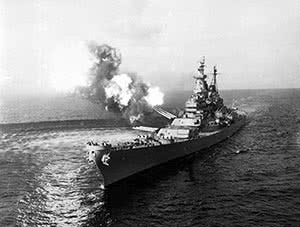
USS Missouri fires her guns against enemy positions during the Korean War.
The battleship USS Missouri is best known for its role in World War II, which included the Sept. 2, 1945 signing of the Empire of Japan’s unconditional surrender in Tokyo Bay, ending the war. But the Missouri also played a key role in the Korean War. As we mark the 60th anniversary of the armistice that ended the Korean War on July 27, 1953, here’s a brief look at the Missouri’s support of U.S. forces off the coast of Korea during America’s “Forgotten War.”
The USS Missouri was ordered to Korea at top speed in June 1950, battling typhoon winds in order to offer aid and support to U.N. troops on the southeastern shore of South Korea in June 1950. Soon after, the Missouri traveled farther north to aid U.N. troops behind enemy lines at Inchon. When the North Koreans retreated, the Missouri led a task force that landed at Wonson, North Korea.
As U.N. troops pushed into North Korea, China entered the conflict, forcing U.N. forces to pull back. The USS Missouri’s 16-inch guns were able to provide enough support to the U.S. Marines to cover their sea evacuation from the Chosin Reservoir.
In late March 1952, the Missouri was relieved of its duties in the Korean Combat Zone. In October 1952, the Missouri returned to North Korea to carry out naval raids bombarding factories, transportation lines and communications facilities. The USS Missouri left Korea for the last time on March 25, 1953.
During the Missouri’s two deployments in Korea, the ship fired a total of 3,000 tons of projectiles. (Source: Missouri State Museum USS Missouri exhibit.)
USS Missouri Today
On March 31, 1992 the USS Missouri was decommissioned for the final time, and on Jan. 29, 1999 the ship was stationed as a centerpiece of the Battleship Missouri Memorial in Pearl Harbor.
Currently, the USS Missouri serves as an exhibit at the memorial, offering historical displays original to the ship and its service. For more information about the USS Missouri and the Battleship Missouri Memorial, visit ussmissouri.com.
Medal of Honor Recipients
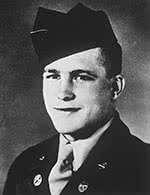
Three Missourians received the Medal of Honor for their service in the Korean War. The Medal of Honor is the United States’ highest military honor, awarded for acts of valor above and beyond the call of duty. The medal is awarded by the President in the name of Congress to U.S. military personnel only. All three Missourians received the award posthumously.
Richard G. Wilson
Rank and organization: Private First Class, U.S. Army, Co. 1, Medical Company, 187th Airborne Infantry Regiment.
Place and date: Opari, Korea, 21 October 1950.
Entered service at: Cape Girardeau, Mo.
G.O. No.: 64, 2 August 1951.
Citation: Pfc. Wilson distinguished himself by conspicuous gallantry and intrepidity above and beyond the call of duty in action. As medical aid man attached to Company I, he accompanied the unit during a reconnaissance in force through the hilly country near Opari. The main body of the company was passing through a narrow valley flanked on 3 sides by high hills when the enemy laid down a barrage of mortar, automatic-weapons and small-arms fire. The company suffered a large number of casualties from the intense hostile fire while fighting its way out of the ambush. Pfc. Wilson proceeded at once to move among the wounded and administered aid to them oblivious of the danger to himself, constantly exposing himself to hostile fire. The company commander ordered a withdrawal as the enemy threatened to encircle and isolate the company. As his unit withdrew Private Wilson assisted wounded men to safety and assured himself that none were left behind. After the company had pulled back he learned that a comrade previously thought dead had been seen to be moving and attempting to crawl to safety. Despite the protests of his comrades, unarmed and facing a merciless enemy, Pfc. Wilson returned to the dangerous position in search of his comrade. Two days later a patrol found him lying beside the man he returned to aid. He had been shot several times while trying to shield and administer aid to the wounded man. Pfc. Wilson’s superb personal bravery, consummate courage and willing self-sacrifice for his comrades reflect untold glory upon himself and uphold the esteemed traditions of the military service.
Billie G. Kanell
Rank and organization: Private, U.S. Army, Company I, 35th Infantry Regiment, 25th Infantry Division.
Place and date: Near Pyongyang, Korea, 7 September 1951.
Entered service at: Poplar Bluff, Mo.
G.O. No.: 57, 13 June 1952.
Citation: Pvt. Kanell, a member of Company I, distinguished himself by conspicuous gallantry and outstanding courage above and beyond the call of duty in action against the enemy. A numerically superior hostile force had launched a fanatical assault against friendly positions, supported by mortar and artillery fire, when Pvt. Kanell stood in his emplacement exposed to enemy observation and action and delivered accurate fire into the ranks of the assailants. An enemy grenade was hurled into his emplacement and Pvt. Kanell threw himself upon the grenade, absorbing the blast with his body to protect 2 of his comrades from serious injury and possible death. A few seconds later another grenade was thrown into the emplacement and, although seriously wounded by the first missile, he summoned his waning strength to roll toward the second grenade and used his body as a shield to again protect his comrades. He was mortally wounded as a result of his heroic actions. His indomitable courage, sustained fortitude against overwhelming odds, and gallant self-sacrifice reflect the highest credit upon himself, the infantry, and the U.S. Army.
Charles R. Long
Rank and organization: Sergeant, U.S. Army, Company M, 38th Infantry Regiment, 2d Infantry Division.
Place and date: Near Hoengsong, Korea, 12 February 1951.
Entered service at: Kansas City, Mo.
G.O. No.: 18, 1 February 1952.
Citation: Sgt. Long, a member of Company M, distinguished himself by conspicuous gallantry and intrepidity above and beyond the call of duty in action against an armed enemy of the United Nations. When Company M, in a defensive perimeter on Hill 300, was viciously attacked by a numerically superior hostile force at approximately 0300 hours and ordered to withdraw, Sgt. Long, a forward observer for the mortar platoon, voluntarily remained at his post to provide cover by directing mortar fire on the enemy. Maintaining radio contact with his platoon, Sgt. Long coolly directed accurate mortar fire on the advancing foe. He continued firing his carbine and throwing hand-grenades until his position was surrounded and he was mortally wounded. Sgt. Long’s inspirational, valorous action halted the onslaught, exacted a heavy toll of enemy casualties, and enabled his company to withdraw, reorganize, counterattack, and regain the hill strongpoint. His unflinching courage and noble self-sacrifice reflect the highest credit on himself and are in keeping with the honored traditions of the military service.
The AMBER Alert™ Program is a voluntary partnership between law-enforcement agencies, broadcasters, transportation agencies, and the wireless industry, to activate an urgent bulletin in the most serious child-abduction cases. The goal of an AMBER Alert is to instantly galvanize the entire community to assist in the search for and the safe recovery of the child.
Missouri law requires that any law enforcement agency receiving a report of a missing child or adult shall immediately enter the name of the person into the National Crime Information Center (NCIC) and into the Missouri Uniform Law Enforcement System (MULES) with all available identifying features and information.
To report a missing person, contact your local law enforcement agency.
Stay StormAware. In Missouri, many local governments, media outlets and others sources offer free services that automatically send out notifications alerting users to severe weather advisories, severe weather and flood watches and warnings. Learn more about alerts in your area.
The United States Congress is the legislative branch of the federal government. Congress is composed of two chambers, the House of Representatives and the Senate, and is responsible for making laws.
Senate
The Senate is made up of two senators from each state, regardless of population. There are 100 senators (two from each of the 50 states), who each serve six-year terms. Approximately one third of the Senate stands for election every two years.
Missouri’s U.S. Senators
Josh Hawley
B40A Dirksen Senate Office Building
Washington DC 20510
(202) 224-6154
Eric Schmitt
260 Russell Senate Office Building
Washington DC 20510
(202) 224-5721
The number of representatives each state has in the House is based on each state’s population as determined in the most recent United States Census. All 435 representatives serve a two-year term.
The power of the Executive Branch is vested in the President of the United States, who also acts as head of state and Commander-in-Chief of the armed forces. The President is responsible for executing laws created by Congress, is elected to office every four years and cannot serve more than two terms.
Vice President
The executive functions of the Vice President include participation in Cabinet meetings and, by statute, membership on the National Security Council and the Board of Regents of the Smithsonian Institution.
President’s Cabinet
The Cabinet includes the Vice President and the heads of 15 executive departments.
Boards, Commissions, and Committees
These organizations were established by congressional or Presidential action, and their functions are not limited to supporting a parent agency. Examples include the Arctic Research Commission, the Barry M. Goldwater Scholarship Foundation, and the Social Security Advisory Board.
Judicial Branch
The Judicial Branch explains and applies the laws. This branch does this by hearing and eventually making decisions on various legal cases. Where the Executive and Legislative branches are elected by the people, members of the Judicial Branch are appointed by the President and confirmed by the Senate.
U.S. Supreme Court
The Court is the highest tribunal in the Nation for all cases and controversies arising under the Constitution or the laws of the United States.
U.S. Court portal
Your portal to the judicial branch of the Federal Government. Includes educational resources, rules and policies, statistics, forms, and a court locator.
Judicial Branch information
General links to lower courts, special courts (including military courts), and support organizations. Visit the Federal Judicial Center to learn about how the courts work, how they are organized, and how they fit into the U.S. system of government.
Courts of Appeal
The 94 U.S. judicial districts are organized into 12 regional circuits, each of which has a United States court of appeals. Missouri is in the Eighth Circuit.
Visit the Office of State Courts Administrator website at courts.mo.gov for information about Missouri courts, legal resources, news and publications, attorney information, and more.
The Missouri State Public Defender provides legal representation to all indigent citizens in Missouri at the levels of the State Trial Court, Appellate Court, Missouri Supreme Court, and U.S. Supreme Court.
Municipal Courts
The municipal division of the circuit court has original jurisdiction to hear and determine municipal ordinance violations. Search for court-specific information by municipality. Find a municipal court »
Much of the typical, day-to-day interactions Missourians have with government center around their local administrations and public servants. Whether it is a city, municipal or county government, local governments and local elected officials are Missourians’ primary resource for everything from protection and the administration of justice to the support of infrastructure and social services. Below are some resources to help you connect with your local government.
Missouri Municipal League
The Missouri Municipal League promotes the cooperation of Missouri cities, towns and villages as well as the interest and welfare among them in order to improve municipal government and administration in the state.
Missouri Association of Counties
The Missouri Association of Counties (MAC) is a nonprofit corporation established to provide assistance to its member counties in matters pertaining to local, state, and federal government activities.
The municipal division of the circuit court has original jurisdiction to hear and determine municipal ordinance violations. Search for court-specific information by municipality.
Missouri State Public Defenders
A Missouri State Public Defender provides legal representation to all indigent citizens accused of or convicted of crimes in Missouri at the levels of the State Trial Court, Appellate Court, Missouri Supreme Court, and United States Supreme Court.
Search for Prosecuting Attorneys
Use this directory to find your county’s prosecuting attorneys or find them on a list of all the prosecutors in the state.
Tourism & Recreation
Aug 17, 2011
Find Missouri Fun
Welcome to Missouri, we hope you Enjoy the Show! Check out VisitMo.com, the official website for the Missouri Division of Tourism, for all the resources you need to plan your Missouri adventure, whether you’re interested in arts and culture, family fun, sports and gaming, outdoor recreation, or nightlife and entertainment. And be sure to check out our Trip Ideas page to view the best Missouri destinations and getaways.
Arts & culture – Search for museums, galleries and live theater
Entertainment – Search for sports events, live music, dinner theater and casinos
Family fun – Search for zoos, museums, and amusement parks
Food & Drink – Explore restaurants, wineries and breweries
Sightseeing – Visit Missouri landmarks and historic sites
Go Outside
You’ll never tire of the outdoor activities available in Missouri. Get everything you need to start your outdoor adventure, from camping to fishing to hiking to hunting.
Missouri state parks and historic sites provides recreational opportunities for enjoying the state’s most outstanding natural landscapes and cultural landmarks.
Conservation areas in Missouri protect our state’s wild resources and helping Missourians connect with their natural heritage, sustaining diverse, healthy plant and animal communities now and for the future.
Whether you want to visit a winery, pick out the perfect pumpkin or get lost in a corn maze, check out all Missouri has to offer for families looking for fun on the farm.
Missouri is home to world class hunting. Whether it is a trophy buck, giant gobbler or premier fur that you’re looking to bag, Missouri’s Department of Conservation (MDC) provides the perfect hunting experiences and habitats. Look below for more information about hunting and trapping in Missouri.
Get started hunting with hunter education. It’s required in Missouri, and it qualifies you to buy a firearms hunting permit. Our Discover Hunting workshops teach better shooting and hunting skills. Find hunter education opportunities near you and online.
Missouri offers numerous managed deer hunts for archery, crossbow, muzzleloading and modern firearms from mid-September through January. These hunts achieve deer management goals while also providing additional hunting opportunity. Hunters are selected by a weighted random drawing system.
Fishing
Over 1.3 million Missourians fish. Some of them fish for sport or relaxation; others fish only for food. They all spend quality time on the water and then return home to a satisfying meal of sizzled or grilled fish that they have caught themselves.
Fishing is easy to learn and fun to do, especially with your friends and family members. Find locations, techniques and programs to help you catch fishing fever!
The Missouri Department of Conservation (MDC) issues hunting and fishing licenses and manages Missouri's wildlife so that future generations have the opportunity to hunt and fish as we do today. Their website also provides education on hunting and fishing.
Missouri State Parks, a division of the Missouri Department of Natural Resources, offers trout fishing at three majestic state parks. Bennett Spring, Roaring River, Montauk state parks offer spring-fed, pristine waters flowing through the parks that provide the essential quality required for trout to thrive for fisherman to enjoy.
If you witness or suspect a wildlife violation, report it to your local conservation agent or call the toll-free number —1-800-392-1111— which is staffed 24 hours a day. You may remain anonymous, and you may ask to be considered for a reward if you wish.